Promoting the Second Chairs
Finding Interesting Characters in Austen's Supporting Cast

I am in the process of reviewing and tweaking the eight volumes of the Bennet Wardrobe Series in celebration of the Tenth Anniversary of the publication of Volume One, The Keeper: Mary Bennet’s Extraordinary Journey. My attraction to Austen’s secondary characters found full voice in the Series where I considered the destinies of P&P’s four sisters and the senior Bennets in the service a great purpose, the re-establishment of the universal constant that took form in Elizabeth and Darcy’s eternal love story.
Recently, I returned to Lessers and Betters, an exploration of Kitty Bennet’s character which emerged at the same time as the Kitty sequence in the Wardrobe. ‘Barve Kitty’ was the result—she was no longer ‘the girl who coughed'.’
The Ambassador’s Wife moves characters down the timeline by five years. The book appeared on Amazon worldwide in mid-April.
Please enjoy these musings on the development of secondary (and original) characters in the Austenesque Universe.
We all love Jane Austen’s leading men and women. They flash across the heavens like a brilliant comet, leaving an enduring afterimage. We are attracted to them and then arrested by them. That is Jane Austen’s power.
But none of these characters is perfect. Instead, they are perfectly imperfect.
What keeps us coming back is that they are interesting and surrounded by fascinating characters—and caricatures. For every Anne Elliot, there is a Lady Russel and a Sir Walter. For every Emma, there is a Mr. Woodhouse and a Harriet Smith or Miss Bates.
These people are, in many ways, compelling enough to step forward from the background into stories that revolve around them and their personality traits. By doing so, authors can turn them from two-dimensional figures into full-blown people with lives outside the Canonical spotlight. How might those individuals live, and what might their stories be?
Whatever they are, because the leads themselves were interesting enough for us to remember, I wager that these secondary characters are compelling. They are people I keep returning to when I am not writing ODC-focused stories.
I have spent a decade writing stories that bring Austen’s secondary characters into leading roles: Mr. and Mrs. Bennet and Mary, Kitty, and Lydia in The Bennet Wardrobe, for instance. However, there is a special place in my heart for Richard Fitzwilliam and Kitty Bennet as I discovered them in Lessers and Betters.
Nine years ago, in 2017, I began examining the nature of Kitty Bennet as I started working on (what was then the second volume) of her story in the Wardrobe. I found I had to dig deeply to discover her inner strength, what was needed to make her more than the girl who coughed. As I mulled, a whole new story about a Brave Kitty jumped forward. That evolved into Of Fortune’s Reversal. There, Kitty Bennet found her inner resolve as the family’s life was irreversibly changed in the face of Mr. Bennet’s death before the Netherfield Ball.
The young woman, forced to grow up quickly after her father’s death, but also thanks to her mother’s determination save her youngest girls by sending them to school. She performs an act of remarkable heroism, saves a child, and, in the process, attracts Richard Fitzwilliam’s attention. Their love story is Of Fortune’s Reversal’s center.
The Lessers and Betters universe operates on the belief that class is an imaginary distinction conferring no better manners on the haves and no lesser nobility on the have-nots. This Pride and Prejudice variation expands Jane Austen’s vision of love by asserting that the deepest human emotions are universal and ignore wealth or status.
So, when I was writing OFR, two servants waved at me: Annie Reynolds and Henry Wilson. A parallel love story, below stairs as opposed to the parlor, insisted that it ought to be told in a free-standing way. I bowed to the demand—to my lasting pleasure. Thus, The Maid and the Footman appeared.
Now, the world has moved on. Napoleon has been exiled to the South Atlantic. The four have become fast friends. A new face—James Foote, the former Longbourn footman who was introduced in my novel, In Plain Sight—has joined the group. Foote is Henry Wilson’s partner in harness to General Fitzwilliam’s British Intelligence efforts and has supported the Darcys (The Grail, The Sailor’s Rest, and In Westminster’s Halls). Together in the spring of 1819, they travel to Constantinople bearing the terms of a draft treaty to be negotiated between Britain and the Ottoman Empire.
The Ambassador’s Wife continues the upstairs/downstairs approach with the Fitzwilliamses (Richard and Kate—the Baron and Baroness St. Jean) navigating the gentry’s halls while the Wilsons work to winkle information from the servants. However, I bring Anne Reynolds Wilson and Kate Bennet Fitzwilliam to the fore as the detectives piecing together clues to two murders at the British Embassy.
I found the idea of making the women the leads in unraveling the mystery behind the deaths and the theft of the treaty appealing. Anne is the niece of Pemberley’s housekeeper and had first appeared as an upstairs maid in Lessers and Betters. Now she is a valued part of Fitzwilliam’s British Intelligence team. She and the baroness have become close friends, much as the Fitzwilliam and retired Sergeant Wilson have. The differences of station most definitely have not been preserved!
We must remember how the then-Annie Reynolds demonstrated the sharp edge of powers in Lessers and Betters.
Excerpt from Chapter 18 of Lessers and Betters
Annie hunched her shoulders, showing her distaste for her following thoughts. “A central part of their plan has Winters drugging Miss Margaret and forcing the maid to carry the child from the room and out of the house. That is what the spy would expect, and that is what will happen, in a way.
“I fully appreciate that we do not want Miss Margaret sensible at any time. The fright she would receive might scar her for years. So, I have no objection to ensuring she is sound asleep, even if that slumber is drug-induced.
“Frankly, my lord, Winters is a cretin. Do we know what drug his master gave him? What promise do we have that Winters will not, even unintentionally, administer a fatal dose?
“We cannot allow Miss Margaret to drink anything prepared by Winters’s hand. I think you understand what I am saying, my lord.”
Fitzwilliam’s eyes widened. He whistled below his breath and said, “Sergeant, take this woman’s words to heart. They say that the female of the species is deadlier. Your Miss Reynolds just argued that we ourselves must drug the child tomorrow evening.”
I believe that is what sets The Ambassador’s Wife apart from many other Austenesque variations. The women take the lead, with the former maid pulling all the threads into a complex tapestry that sheds light on the deceit and treachery that led to murder. This inversion of gender and class makes for a more interesting tale. Consider the following excerpt from The Ambassador’s Wife.
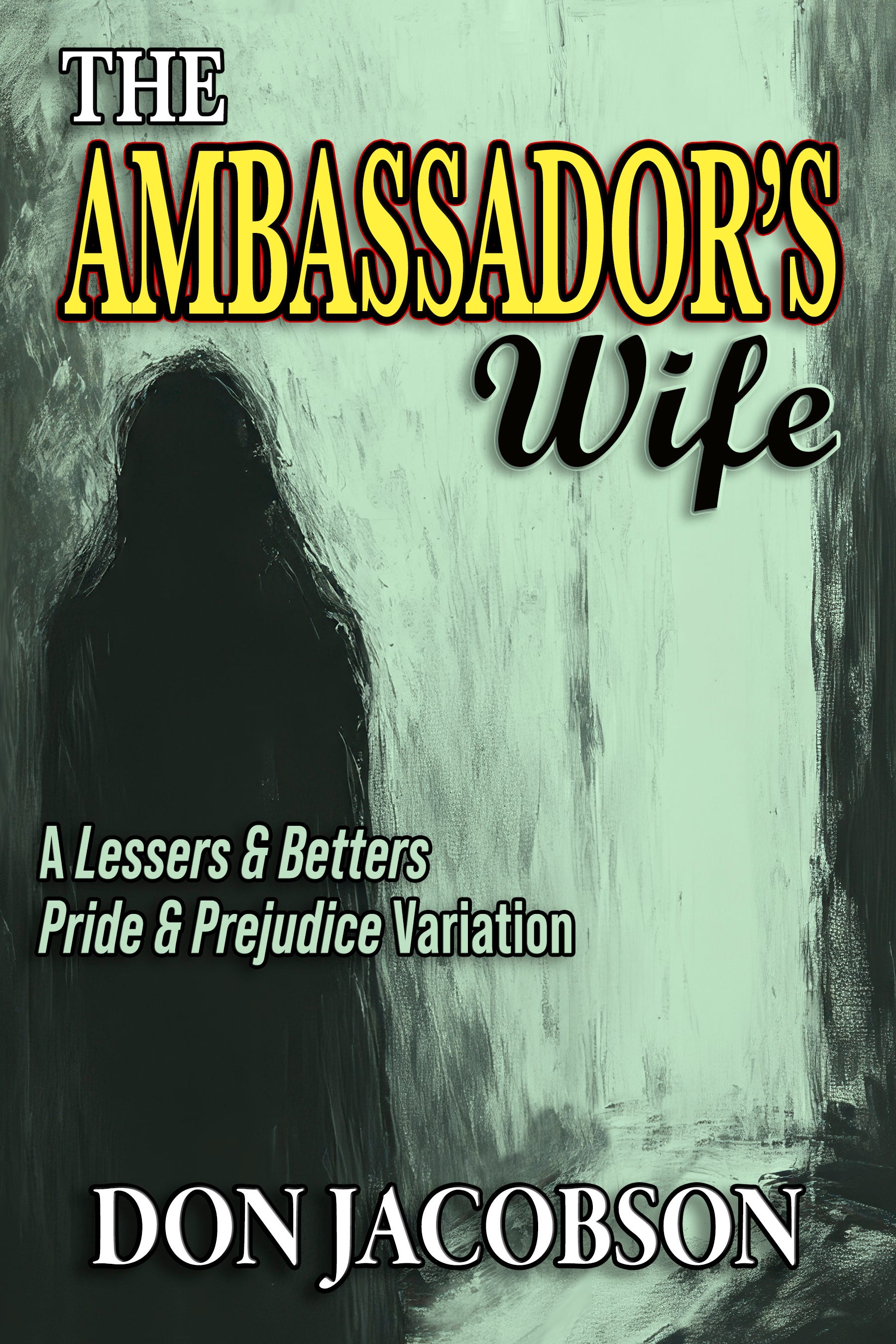
Link to Amazon Worldwide: https://mybook.to/AmbassadorsWifePandPVa
&&&&
Chapter 26
The British Residence Parlor
Kate and Anne had used their time behind closed doors well, preparing their props for their dramatique. A mint-green sprigged muslin tent—a summer shawl transformed from its usual purpose, equally eye-catching as it was obscuring—hid all. The two women sat primly, facing their audience across the draped center stage.
No Greek chorus were they, nor Sirens luring men to their end. Theirs were to be the Delphic words of the heroines and oracles, prophetesses divining the entrails spread before them.
Like high court barristers, they faced an ethereal tribunal, unseen eyes and ears, to present their case, a dark one, dealing with espionage, treason, and murder. All in the room knew many of the specifics. Only one in the dock had the entire picture. The way the three army men directed the attendees was unmistakable. Their granitic mien told all. This was to be a grand jury, presenting evidence that would lead to a formal accusation and immediate trial. Afterward, those same attorneys would turn red their somber robes, don their black caps, and pronounce the convict’s doom. Lady Kate and her comrade were all-powerful tellers of fact and punishment. Fitzwilliam and his men would be the enforcers.
Removing the baron from the field flipped the counselor’s and the nieces’ expectations on their heads. Women never controlled the stage—unless they were Maria Theresa of Austria or Catherine of Russia. The silence deepened in expectation of the opening statement, obviously to be made by the highest-place lady. Thus, an additional surprise: despite her rank, the baroness deferred to the woman many thought to be her lady’s maid.
The sergeant’s wife scanned the audience. “Please do not interrupt my story. My associate,” she looked left at Kate, “will offer her own interpretation of certain pieces of evidence.”
The general snorted, perhaps imagining his late aunt’s outrage at a mere referring to a member of the aristocracy, even one occupying the lowest rung of the coroneted class, as her ‘associate.’ His disruption earned him another pointed stare, something frequently earned and never ignored. He subsided into parade rest.
***
Anne smoothed invisible wrinkles from her skirts before she continued. “While we represent three powers, none of us is so innocent as to be ignorant of the twisted path the affairs of nations follow. There is a greater game afoot, one we cannot pretend will leave any of the players unaffected. I say this, not to apportion blame, but to cast what will be revealed in a bright light, to remind us the damage our schemes can cause despite our justifications that all happens for the greater good.”
Standing, she lifted the tented material, revealing a disparate collection of goods. “Bodies falling have a way of obscuring more interesting clues. Those unaccustomed to weighing individuals in scales where the fate of nations hangs in the balance tend to focus their attention on the final rictus, reshaping a face or the blood pudding congealed on a carpet. We do not have that luxury.
“Persons like us cannot ignore what seems unimportant. However, like the old legend of the magic spinning wheel that turns straw to gold, in our world, the mundane has a way of leading us to enlightenment. Fragments, when combined with other grains of sand, can become a great dune rising to scrape the sky.”
A writing slope dominated the center of the low table. A wine bottle and an empty goblet stood adjacent. The table was low enough for all to see the knife, its blade wrapped in paper. Other items included a folded document, quills, two men’s gloves, a few scraps of paper, and a pair of pantaloons—a few coins of varying denominations filled out the collection.
Anne paused to allow the group to take in the display. “The significance of each of these will become evident. However, I am going to set aside their consideration in favor of assaying the field of play.”
Kate roused herself to add, “Before Mrs. Wilson continues, we are all professionals here.
“No, my dear Misses Tatiana and Marie, do not protest. Even if you two are truly your ambassador’s nieces, as you so quaintly put it, your ability to grant and collect favors has made you vital adjuncts in the French and Russian missions’...mission...to collect bits and bobs that increase your government’s understanding.”
The baroness did not miss the flicker of interest sparking in Ivanov’s eyes. “Let us drop pretenses. Do not embarrass yourselves by playing the blushing bride. Each of you knows of the great treasure my husband brought with him from London.
“How that news became common currency will demand a clearing of Whitehall’s back corridors. That would typically be neither here nor there except that murder has taken two people in the last twelve hours.
“When I was a young girl, I could be led around by my nose. Then temblors,” Kate touched her eyepatch, “rocked me and demanded I toss off my jejune behavior and grow into a pragmatic woman. I cannot accept that these outrages are unconnected with my husband’s task.”
The baroness settled back into the cushions and turned the floor back to Anne.
That worthy looked at each person facing her, a knowing smile reshaping her face. “The news that a draft treaty between London and the Porte arrived at the Residence seems to have set the cat amongst the pigeons. I doubt if my next will astonish and amaze the cynics arrayed before me, but I must lay it before you.
“The Baron St. Jean is more than a retired military man. Throughout his career, my friend’s husband has found it useful to conform to society’s expectations for someone of his class.
“When he served the Duke, his enemies would often underestimate his force’s capabilities, assuming the colonel, as he was then, an earl’s second son, had purchased his rank. Far too many of those noble gentlemen hid in the safety of the baggage train, ready to flee to Lisbon and the next frigate home when they sent their regiment forward into the mêlée’s meat grinder.
“Units condemned to suffer under that sort of leadership usually broke and ran, outpaced only by their commander.
“Napoleon’s allies thought Fitzwilliam had vastly more pounds than sense, akin to other officers in many low-numbered regiments.
“Of course, that meant that they willfully ignored the scars lacing his cheeks and knuckles. The Thirty-Third was the Duke’s spear, prying open gaps across the Tyrant’s line. My husband, Sergeant Wilson, fought under the general in Belgium when Captain Wickham saved us all.[i]
“I will not offer more than to suggest that you would be sorely mistaken if you took the baron at face value and saw nothing but a bluff clubman who won a fifty thousand pound bounty from the Regent because he managed to stay in his saddle at Waterloo. Suffice to say that he has hidden qualities which led Lord Castlereagh to see him as the right man to carry the draft to Constantinople.”
Covering her mouth to clear her throat, Anne gave her husband a grateful look when he rose and brought a carafe of water, dew speckling its sides.
A sip restored Mrs. Wilson. “Thank you, Henry, dear.”
“As distasteful as it is to ignore a good woman’s end,” she continued, “We must set aside Lady Liston’s murder. There is nothing to link her death with the treaty directly, but given what we know of her movements in the minutes before her death, we can suppose that she came upon her killer trying to access the document stored in Sir Robert’s office.
“An Oxford debater could argue that her death was the result of the draft being in the Residence. Rather than belabor the point, I will concede without objection.
“An even weaker connection is the relationship between her murder and Major Wallingsham-Smythe’s, except to say they happened while the draft was under the ambassador’s roof.”
Mrs. Wilson gripped the knife’s sharkskin grip and lifted it high before carefully sliding off the paper sheath. Light flowing through the windows glinted carmine on the stained blade. “The dagger that was the instrument of Lady Henrietta’s demise is purpose-designed but in no way unique and found in a hundred warrens in a dozen cities. Why, I imagine our own Mr. Foote may have one or more like it secreted around his body.”
James had the grace to squirm at the attention. Fitzwilliam noted Ivanov’s hand twitch lightly—observing such micro-movements was his stock in trade. Marie caught Tatiana’s left hand, where it rested on her thigh, bunching her skirt’s silk.
Anne surveyed the items spread before her. “The rest of this debris marks the meager accounting of a man’s life. These are a sampling of Edward Wallingsham-Smythe’s possessions.
“What I conclude is that the major was typical of a younger son in an aristocratic family: used to living beyond his allowance and enjoying inclinations that would be frowned upon if they had become known in polite society.
“His reputation is rife with examples of his gambling debts and affairs—none of the heart, it must be said—with actresses and some of the ton’s less discriminating widows.”
Anne’s expression radiated we are all adults here. “When it came to finding comfort in a lady’s soft arms, I wager the major was happy his transport to Constantinople made port at the Rock and Valletta. Since arrival, though, I wonder if he found satisfaction.”
Anne used the weapon as a pointer. “These scraps are fifty pounds’ worth of vowels. How he redeemed them is of little interest. However, twisting what my taciturn husband is fond of noting about six-legged vermin, I see these notes of hand and am sure countless others are hiding in the walls. These or those were made worthless by his last breath.
“I thank the stars that neither my husband nor the other gentlemen in our suite risk our daily bread on the turn of a card, much less on the number of flies alighting on a horse apple dropped on St. James Street. Worry’s burden would be too much.
“If we are talking hundreds of pounds, an income for which millions of Britons could only wish, even the most louche—unless he were the Regent—would blush at the debt’s weight.”
Pausing to sip from her glass, “Speculation is an excellent way to enjoy a glass of wine with a friend, but such diversion depends not on evidence, but rather emotion. That is an indulgence I refuse to allow myself.
“I spoke of grains of sand. Many lay on this table, allowing me to conclude that Major Smythe was a weak link. It is no stretch to take the next step and suppose that Major Smythe found the draft treaty too tempting.”
The general interrupted. “Take care, Mrs. Wilson: you risk besmirching the reputation of a man who cannot defend himself.”
Used to her chief’s method, Anne did not bridle at his challenge. “I am not suggesting that the military attaché would voluntarily betray the ambassador’s trust. He was not venal to his core. However, his poor judgment with cards may have left him open to pressure, leading him toward a solution to his plight.
“Fear not, General, lest Aunt Adelaide discipline me, I promise I will not broadcast my conclusions any further than this audience. Major Smythe’s disgrace was not in that he was a traitor but rather that he was thought to be disloyal but had not finalized his perfidy.”
[i] Please refer to Of Fortune’s Reversal and The Keeper: Mary Bennet’s Extraordinary Journey for The Ballad of George Wickham, Hero of Hougoumont Woods.
Interesting! Sounds like lots of fun reading of your books out there! I better get busy!lol