The Inner Voice
Characters' Thoughts in Austenesque Fiction

While I have been writing for over half a century (dating back to my high school newspaper days), I have only been involved in fiction since 2015, though many would suggest that my decades in advertising have left me well qualified to write fiction. These past ten years have been my most productive: thirteen full novels, four novellas, and three short stories, well over 1,000,000 words.
As I worked my way through these stories, I discovered that my writing itself changed, becoming more burnished. I find myself involved in an ongoing experiment in both form and function. There is no set formula as to how this evolution is undertaken. Perhaps the changes are so minute as to be imperceptible. My natural inclination is to fiddle and try to find new ways to express myself in Austenesque fiction, to bring readers to a different understanding of well-known characters and memes.
This previous is not pride, but rather an explanation.
I think my most profound change came during the time of enforced isolation in 2020. Pausing life was the norm. Removing the external gave the internal—so readily ignored in the blinding light of the everyday—a chance not just to step forward, but to become dominant. And my internal was a watchfulness through which I observed, processed, and stored. During the Quarantine, I—we—all have had ample time to watch and contemplate.
Early on, my muse, Pam, parked me in front of the hi-def and told me she had found a Netflix documentary called Five Came Back. This was a film about five great Hollywood directors—Ford, Capra, Wyler, Stevens, and Huston—who set aside their fame and put their careers on hold to aid the US war effort in World War II. I was so entranced with the four parts of the tale that I purchased the book on which it was based.
While each individual’s story was compelling, William Wyler’s stood out as particularly profound, showing how a pivotal experience altered his creative path.
Wyler is known for his remarkable œvre which began in the 1930s and flew above the Hollywood landscape through the 1960s. Before World War II, Weyler was a master of extracting the best possible performances from his actors (see Bette Davis in 1938’s Jezebel), whether in a drama or comedy. Thirty-six received Academy Award nominations, and fourteen won.
Wyler’s work is divided by a bright line. He found his voice in the war. His first Director’s Oscar was for Mrs. Miniver (1942). Miniver, though, was completed before America’s entry into the war and Wyler’s departure for Europe. The film was the French Jewish refugee’s appeal to Americans, saying that the perils of fascism and authoritarianism could not be ignored.
However, his first film after returning from two years of flying with the US Eighth Air Force is widely regarded as a masterpiece. In 1946, Wyler returned to California, emotionally broken and with a 75% hearing loss (caused after his first flight in a B-24) and tried to pick up his life’s pieces. The Best Years of Our Lives is a motion picture that could only have been accomplished by someone who understood.
I will not dwell on the film. Instead, I will shift to the source material.
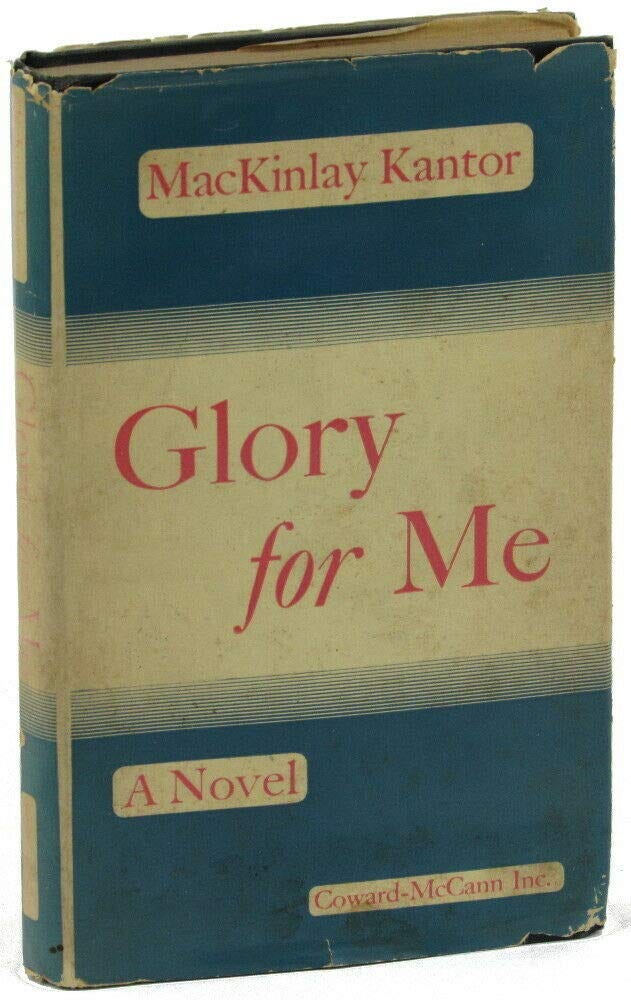
Wyler approached Mackinlay Kantor, a noted journalist, to write something from which a film could be adapted. The mission was to discuss the experience of soldiers, sailors, and airmen returning home to a society that had known war but had not experienced its horrors.
Kantor created not a book but rather a 268-page poem in blank verse: Glory for Me. What is missing is reams of dialogue. Writer Robert E. Sherwood found the movie in Kantor’s reflections and in the odd, broken conversational exchanges.
He frowned from our predicament
He felt they were a lost battalion, huddled close-
The three who’d known destroying flame,
And still perceived its blisters on their hide-
The boy, the elder boy, the man
Who’d felt exploding flare of doom
That women only guessed; and yet
Imagined properly, as women may,
When spreading the tannic dressing of their tears. (p. 267)
Here is an author (Kantor) in full command of his craft, willing to risk it all by delivering a poem to a filmmaker rather than the book or story that was ordered up and paid for. He also gambled—or did not care—that the reading public would turn its back on this literary and likely uncommercial book. Kantor remained true to himself and delivered an honest story. He did so, I am convinced, because the structure of a poem reflected the Homeric qualities of the story of these three nearly nameless men, all the more important because they represented the millions of other nameless men who had left their lives to fight fascism and tyranny. Once I read it in this manner, I could not imagine experiencing its verité in any other format.
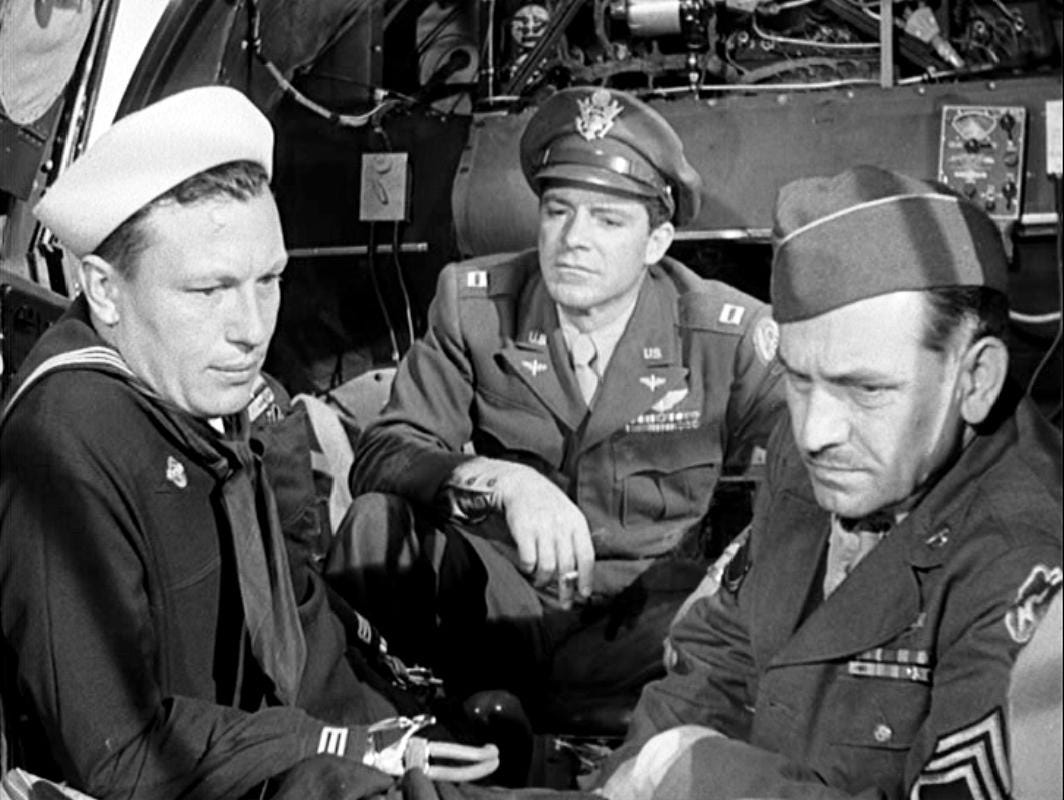
The internal dialogue (above) of Kantor’s character, the middle-aged banker and infantry sergeant, Al Stephenson, reinforced his shared experience with his two younger friends: the physically maimed sailor, Homer Wermels, and the psychologically disfigured bombardier Fred Derry. Yet, the entire book is made up of Stephenson’s rumination: his thoughts, not speech, although not in the first person but rather the third. Try to imagine the passage above as a conversation—or even a soliloquy—and you will see where great writing goes to die.
Through extensive self-assessment, I have been able to trace my evolution as an author back to my earliest days. I have moved from the playwright’s voice being heard through dialogue (some folks previously complained that my characters talked too much) to leveraging the power of the third-person observer, who is more than a fly on the wall. Recall that a theatrical audience is never privy to the musings of any of the characters unless they are verbalized. A book adds another dimension to the experience of engaging with the characters; the reader becomes the observer of what happens on that great grey plane that stretches behind the eyelids of all characters.
Now I have folks who grumble that they are being forced to spend too much time in the characters’ heads. In reply, I offer that we humans spend the bulk of our lives inside ourselves. And that seems to be where my writing is headed in many ways: toward an omnipotent third person.
In my more recent work, I escort readers through Darcy’s or Elizabeth’s thoughts. We can enjoy initial indecision, confusion in opposition to resolution, and final clarity. The same holds for many of the secondary players: Bingley, Jane, Caroline, and Wickham. However, there must be a balance, for people are not creatures of silence. We voice our thoughts for they are like daubs of paint upon a canvas: each may be pleasant to look at, but when taken in conjunction with others, it becomes a complete image. Thoughts contribute to the words spoken by one character which then inspires contemplation in another to bring more words to fill the void between two persons.
Here is where a master like Jane Austen found her strength: the articulation of impressions that shape behavior and propel the story forward.
But it all begins with a worldview—a weltanschauung—through which our characters necessarily filter everything around them. And all of that begins with reflection and contemplation. I ask you to be patient with my work as I explore and experiment to make it the closest approximation of the truth as it exists in this amazing Austenesque world.
Please enjoy the following excerpt from my In Westminster’s Halls which employs the “usual” setup of Elizabeth confiding in Jane. Here, though, we see Jane’s ruminations about her life and situation—and dissatisfaction with being (portrayed as) little more than her sister’s sounding board.
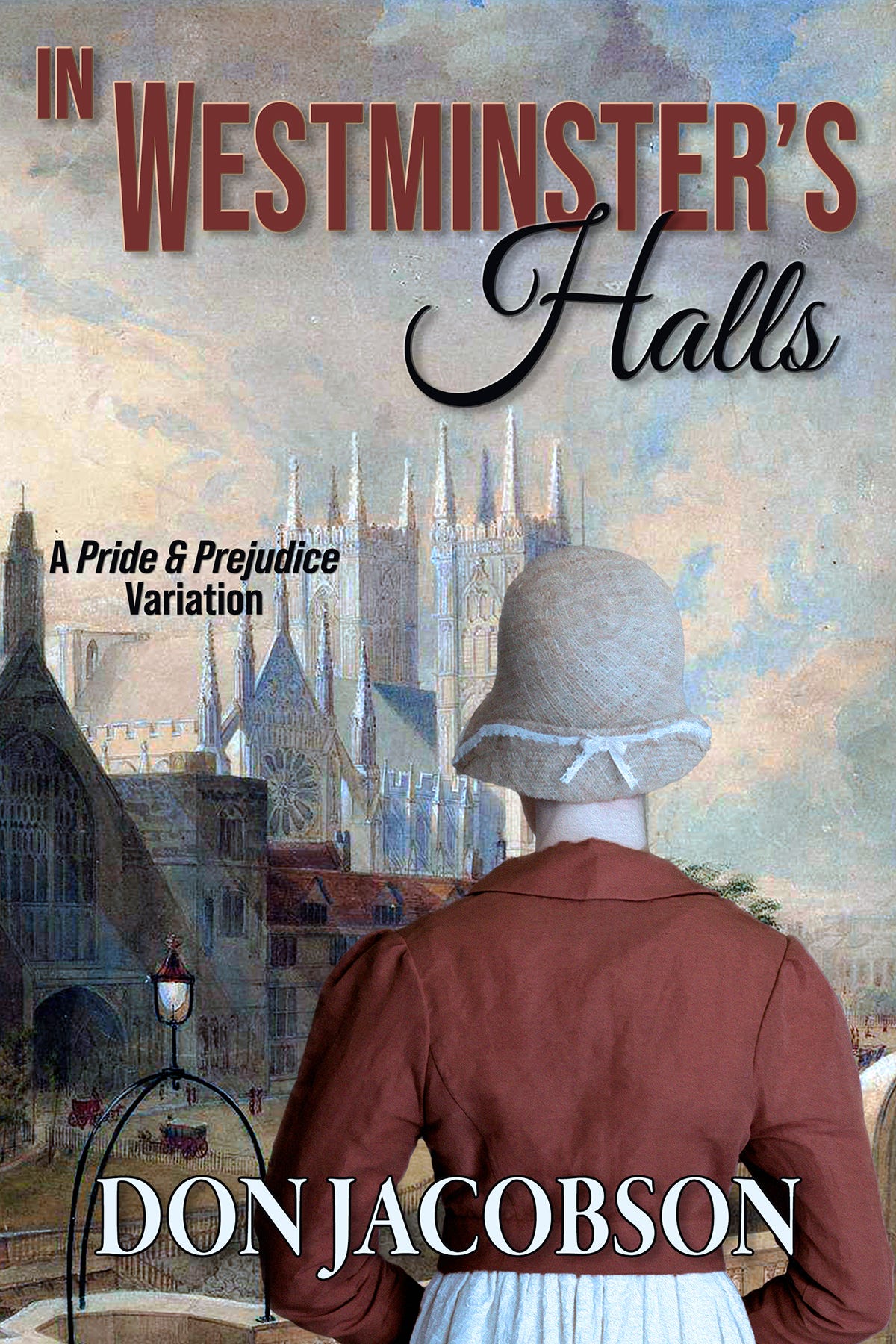
Universal Book Link: https://mybook.to/WestminstersHalls
&&&&
This excerpt of In Westminster’s Halls is ©2024 by Donald Whitfield Jacobson. Any reproduction or other use of this excerpt is strictly prohibited.
Elizabeth has just observed a meeting between Darcy and Wickham in Hyde Park. Not seen by either man, she could not hear their conversation, although she had (see Chapter 11) judged it to be tense.
&&&&
Chapter Twelve
Elizabeth scratched on Jane’s door. A lyric soprano bade her enter, and the two again fell into each other’s arms. As she had done with her father, Lizzy spoke into her sister’s collar, although with Jane—the tallest but one amongst the daughters—the diminutive brunette stood on tiptoes and planted her chin on Jane’s shoulder.
“Oh, Jane dearest, such a trial! How I needed you.
“I love our father, but he cannot begin to understand what that attack meant. He is a man, a Member of Parliament, and sees these slings and arrows as part of life. Yes, Papa was outraged, but in that peculiarly male way. He would have happily called out Mr. Darcy to avenge the slight, although grass for breakfast would not have eased my spirits nor unspoken the words.
“I am not seeking to be another Mary preaching about the fragility of a woman’s reputation. This Darcy character cast not just a shadow on mine; he grabbed it in both hands, tore it in half, threw it in the gutter, and spit upon it.
“If there is a blessing, Papa and I were alone on the walk, away from the crowd, when he accosted us. The shock of Mr. Darcy’s outrageous attack left me unaware of my surroundings.
“Papa, though, has lost much of his antisocial tendencies, having them beaten out of him since he entered the Commons. Once Darcy stormed off, Papa surveyed our surroundings and, as he told me after we came home yesterday, saw no one interested in what was trafficked between two gentlemen with a young lady in the middle.
“Our father found it fitting that the arrival of Mrs. Fitzherbert and her party had attracted the crowd’s attention.”
Jane’s eyes widened, and she gulped in astonishment. “Only our father could equate the unfounded allegations laid against you with those of a woman in a scandalous and unsanctioned liaison with the Prince of Wales!”
Pushing away, Lizzy flew across the room and launched herself onto Jane’s bed. “You must admit the coincidence of her arrival happening simultaneously with Mr. Darcy’s screed was close to poetic or at least worthy of Madame d’Arblay.”[i]
She had just burrowed under the goose-down bolster when a knock sounded. Jane called over her shoulder as she crossed the room, “As soon as I heard you on the stairs, I sent Sarah down for a light lunch and warm drinks.” The maid entered with a tray and placed it on a low table near the fireplace. Jane sat, looked at her sister, and lifted a perfectly shaped eyebrow.
Elizabeth made a mock scowl. “And so, it begins. As the eldest, you have the prerogative to set the agenda for your sisters. I have just settled myself into the cloud-like embrace of your bed, and only now have my hinder parts begun to warm.”
“Oh, Lizzy, stop sounding like Lydia, but be more like her. We both know her appetite. You will feel warmer if you tuck into Cook’s delightful petite repast,” Jane playfully encouraged. “Then we can assay your time here in town with an emphasis on the past few days.”
Lizzy’s grumbling stomach put paid to her complaints about her chilled fundament. Jane also added a few chunks of coal to the sputtering blaze, expanding the orange bubble across the room to entice her younger sister out of bed.
Elizabeth sighed, flipped back the covers, and swung her feet to the floor. Within moments, she was moving a sticky bun onto her plate alongside some cheese and thinly sliced ham.
Between bites, she unspooled the work she had been doing with their father and expectations for the bill. She cautioned Jane to hear what Wickham said and save her thoughts for later.
After studiously avoiding her sister’s eyes, during which her cup of chocolate became her focus, Elizabeth collected herself and assayed yesterday’s Covent Garden pain. Elizabeth could not hide the hurt that clouded her deep brown orbs. The usual sparkle that bespoke Lizzy’s unique spirit dimmed. Jane’s heart ached.
Yet she said nothing, although her hands moved from peaceful repose on her thighs to wringing one over the other in her lap. Tranquil as a swan floating across a pond when seen from above, Miss Bennet showed her distress if one knew where to look.
Elizabeth’s final sortie brought them to the park. “The serendipity of it all—for I did not expect to see either man again, let alone in each other’s company—is astonishing. I attended an entire play without the benefit of dialogue, close enough to see the actors but too far to hear their words.
“Although Mr. Wickham suggested that Mr. Darcy is a dissembler—at least about his support for the bill—nothing about Darcy’s manner spoke of a talent for the stage. Although there were few, every motion told me that Mr. Darcy was doing his best to regulate his emotions. On the other hand, Mr. Wickham reminded me of a child called to the front of the class to recite a paragraph he had not studied.”
Her pause before carrying on told how she continued to wrestle with the problem. “The tale I heard at the Walters’s paints Mr. Darcy in an awful light. I could bear him no goodwill if that were all I had to base my assessment on. Everything I experienced in front of Covent Garden would be borne out.
“But what I saw today leaves me wondering.”
She leaned back in her chair, her eyes focusing above Jane’s head. “The inconsistencies—and there are more than one—in Mr. Wickham’s story bother me now that I have seen the men together. None are so blatant as to bring into question the entire account…”
***
An Epiphany
At some point, Jane felt her attention split. One part of her consciousness was present for Lizzy. For the other, Elizabeth’s voice receded into the background as Jane watched the planes of her face change with each new possibility. The shadows sweeping across fields as the sun moved behind clouds were the closest parallel Jane could draw. She knew her sister’s process, one honed over years of trying to make sense of the world.
When Papa’s express arrived, Jane’s heart leaped. Papa was not one to spend the money—even if the rider was one of Uncle Gardiner’s warehousemen—unless there was an excellent reason. The cause must have been urgent if Mr. Bennet overcame his reluctance to set pen to paper.
Little had changed at Longbourn’s since the Prime Minister’s summons, but much was different for Jane with Lizzy away. Yes, she regularly wrote, if not daily. But letters were not the same as having Elizabeth in the room, moderating Mama’s incessant prattle. Jane missed closing her eyes amidst the torrent to slide an eldritch hand into the rich brown-hued ball of energy buzzing at her elbow. Lizzy’s vivacious impertinence had become the shield behind which Jane hid.
Jane did not begrudge Lizzy Papa’s decision to bring her to town. In their father’s estimation, Longbourn’s second daughter stood far above the others. Lizzy was the distaff side of Papa’s masculine coin.
Lizzy has Papa’s curiosity and wit. Although she would never say it, Lizzy keenly regrets not being born a boy. I watched her envy as the Lucas brothers left for school.
Her agile mind could never be held captive by traditional female pursuits, much as Mama tries to force her square peg into the ordained round hole. Papa encourages Lizzy, but he knows the world will never allow her the freedom she seeks, so he does not do too much to avoid disappointing her.
When Papa asked her to accompany him as his secretary, Lizzy’s excitement was palpable.
While she depended on Elizabeth to be her emotional counterpoint, Jane did not believe –for one second—that she had ceded to Elizabeth any authority on how she felt. She was not Kitty who navigated life as Lydia’s shadow. Nor was she Mary, who could not turn to Lizzy for emotional comfort, the gulf of two years too great. The lonely third child found solace in her books.
Jane scoffed at the idea that the calm Miss Bennet—a creature floating across the stage like Hamlet’s ethereal Ophelia—could not exist without the impertinent Lizzy Bennet. Mrs. Radcliffe or Miss Burney might have written a character like her as a plot device to provide contrast with her cheeky sister and to hold up society’s behavioral mirror to questioning scrutiny. Perhaps there would not be enough Lizziness without Jane’s serenity. But she was no caricature, a bland soul unable to present anything more than a polite smile.
She knew her mind. Yes, she was calm but not placid. Placid was a state of being, a limpid adjective, undisturbed, characterized by the saying Still waters run deep. Jane realized that her demeanor fooled many. But, to her, calm was an active noun.
Jane Bennet was, by nature, a calm woman and always had been. That was her defense against her mother’s effusions. Calm, though, was something many people often replaced with a mile wide and an inch deep. However, life at Longbourn taught her to guard against anything that might damage her sensitive spirit. She did not possess Lizzy’s peculiar ability to forget the past except when it brought her pleasure. Her mother’s every slight, every loud exclamation, echoed and rattled her. Elizabeth soothed Jane until the disturbance faded.
Many a time, Jane wished she could filch some of Lydia’s carefree attitude, if only for one moment of inner peace. However, try as she might, she could not overlook Mary’s reddened cheeks or Kitty’s bejeweled lashes any more than she could ignore a baby wren fallen from its nest sitting forlornly on Longbourn’s lawn, cheeping for its mama.
So, Jane imagined herself as a rock in Longbourn’s stream, parting the flow, resisting water’s ever-present force. She presented a peaceful and unvarying face akin, or so she imagined, to one of the great blue ice glaciers high above Switzerland. Those of brief acquaintance with Jane Bennet saw only a beautiful woman unwilling or unable to exhibit her feelings if she had any in the first place.
The underestimation of her character was a mistake that did her no good. However, that had been her place in the Longbourn hierarchy, one amongst a family filled with singular behavioral quirks.
Papa hid behind books and sarcasm.
Mama feared the north wind that brought hale men to their knees.
Mary judged all with fusty arrogance.
Kitty fretted and coughed.
Lydia flirted, flittered, and tried to steal every scene.
Jane floated wakelessly across life’s pond.
Lizzy tasted every flower and collected character sketches.
The only Longbourn residents who were not epitomes of some character trait were the servants: Mr. and Mrs. Hill, Sarah, and James. They went about their lives working and taking their enjoyment without dramatic pauses onto which observers could project tropes of housekeepers and maids, footmen and butlers. Would that she could live as they did!
The repetitive phrase ‘jewel of the county’ left Jane nonplussed. She was more than a perfectly shaped nose, a classic profile, and sculpted eyebrows—although nobody seemed to consider it. Everyone in the neighborhood, notably Sir William Lucas, praised her appearance to the skies. For that alone, Jane would have fled her childhood home by any means, whether marriage or employment. She was exhausted from constantly trying to meet the community’s expectations.
But there was more, although nowhere near as taxing, but equally bothersome for a young woman approaching her majority.
Jane Bennet was tired of serving only as Elizabeth’s counterpoint.
Being the canvas upon which Lizzy’s portrait appeared had become wearisome. Jane was more than colorful daubs that established a clear image of Elizabeth Bennet for the world to behold.
Thus, when Papa’s letter arrived, Jane resolved to treat the opportunity as more than just an excursion to play the pianoforte behind Elizabeth’s singing or to care for Aunt’s little ones. Jane resolved to establish herself on the stage as more than a backdrop. The first step was her escape from Longbourn. Only afterward could she establish herself independent of her sister, although that would have to wait until she poured the balm upon Lizzy’s ragged wounds.
Jane had dreams. She wanted a loving marriage to a man she could respect and who would cherish her.
I will not be some rich man’s ornament despite Mama’s desires!
[i] By 1807, Fanny Birney had long since married a French expatriate.
I see that I need to reread this book. I enjoyed it immensely the first time.
Close third”