Why A Wardrobe Tenth Anniversary Edition?
The Author Grew

There is an apocryphal story about Ernest Hemingway and his books.
Hemingway was a perfectionist, at least when it came to getting his stories right. He would be under a contract deadline and have the tale framed and set down...first draft, maybe a revised second, but assuredly not final as far as he was concerned.
But the man never felt it was ready for prime time. He’d vanish off to Key West or Cuba for fishing and drinking or...whatever. Of course, the publisher had already advanced Hemingway a pretty penny and wanted a book. They had seen some chapters and knew from experience that there was a book. But they had seen neither hide nor hair of anything resembling the finished product for Max Perkins to edit.
Hemingway just...would...not...let...go. He would come in sunburned with half a bottle in his gullet and tweak and play and do whatever authors do. So, Scribner’s would send Mohammed to the mountain to physically remove the manuscript from Hemingway’s restless hands so they could meet their customers’ ravenous desire for something from the great mind.
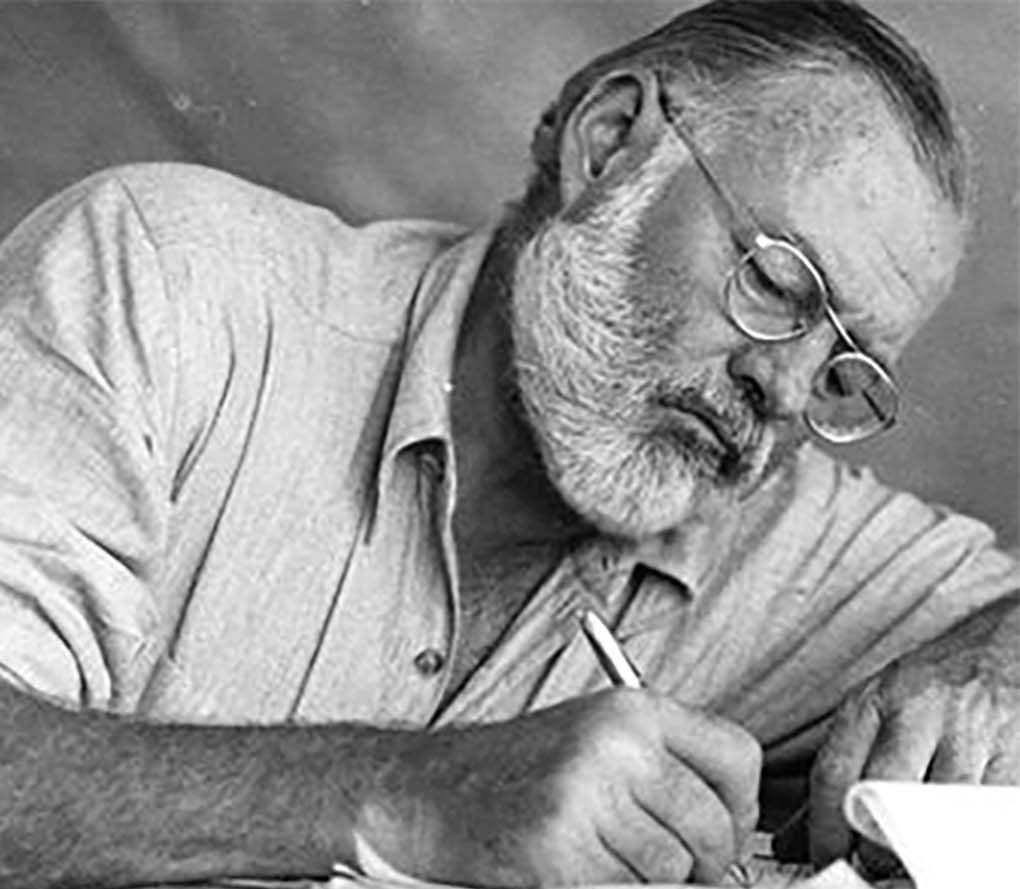
I am not suggesting that I am the great Hemingway, except that I can see places in previous works where I suddenly cringe at the way I wrote them. Essentially, what seemed good nine years ago today seems, well, hmmm.
Many of us (authors, that is) cannot turn their backs on their children—is that not what our books become? We spend as much, if not more, time with each book as our children. Writing gets into our blood. In fact, many pages rolling out of my keyboard also have sweat and, yes, tears. Just as parents—my wife Pam is one—keep an eye on their children even when they are forty-three, so, too, do many authors with books written earlier in their careers.
Throughout the seven-ish years (2015-2022 plus a bit in 2024) I spent on the Wardrobe Series, I would spend six hours a day sitting staring at the screen. The plots were clear, but the words sometimes struggled.
This was early in my fiction writing career. I had been doing marketing copy for forty years and finally laid down my cudgels in 2014, closing my ad agency. But the wordsmithing did not simply stop. My brain turned, and fiction—no comments, please, about ad copy—became my outlet, Austenesque fiction in particular.
Funny thing is, I could write, but my narrative style was, how to put it, not where I wanted it to be.
Over the course of ten years, though, I spent Gladwell’s 10,000 hours building the Wardrobe and then standalones. Each book stretched my writing muscles. Eventually, I found a path which allowed me to match the how with the what.
And, thus, we circle back to the Tenth Anniversary edition of the Bennet Wardrobe books.
I began the series in 2016 with The Keeper: Mary Bennet’s Extraordinary Journey. The story became clear, and the writing came fast, bringing the first seven volumes to light by the end of 2019. Then came COVID and three intervening books—Lessers and Betters, In Plain Sight, and The Longbourn Quarantine.
A publisher and I agreed to re-release the Wardrobe books under their marque, which further slowed the work on the final volume, The Grail: The Saving of Elizabeth Darcy. Throughout 2021, each of the first seven was re-edited and released monthly. Volume Eight dropped in February 2022. In 2024, I published a ninth tale, A Bennet Wardrobe Christmas Miracle.
The Wardrobe books were not static. Their lives were one of evolution from the early days all the way through the 2023 Remastered editions.
Then I decided on building a Tenth Anniversary E-book Box Set. To me, that called for a revisit to see if there was anything I wanted to polish.
There was. As I revisited the revised manuscripts, I discovered several phrases I wanted to update. Duplicated words within the same paragraph or adjacent ones—Roget’s, anyone? Verbal quirks jumped up. My bane is the overuse of “of” as in “Eyes of blue” versus “blue eyes.” And so on.
Here’s an example (gotta love the “Word Compare Document” function). I just reissued the e-book for Volume Six, The Avenger: Thomas Bennet and a Father’s Lament. The 2026 edition features 4,351 revisions. Now, a good number is changing the paragraph indentation from five spaces to three, but they do count since I had to do every single one. Others were grammar, vocabulary, and clarity. Which is which...I will let you be the judge.
Here is a brief sample from Chapter Thirteen of Avenger. Thomas has brought Fanny forward through the Wardrobe to visit Kitty...except the cabinet decides they are needed later. Bennet is finally confessing what has happened as he and Fanny walk the trail on Oakham Mount. These two paragraphs have existed since the book’s first publication in 2018. Since then, I have, I think, learned a bit about how to write, but also how to reach the audience.
&&&&
(Edits can be crazy. The Yellow shows deletes, the green moves or new words.)
At his wife’s arch look of reproof, he raised his hands in defense. “I was simply teasing, my dear. I was offering what turned out to be,, and I fear, a my compliment was rather backhanded compliment. I am afraid, Fanny, that I must relearn proper behavior. I have been lax, and you have been the victim.
“Let me try ‘forehand’ praise.
“As you said, Fanny, you have never climbed Oakham through all after Jane came into the years of your life. world. Yet, you just offered a sophisticated reading of the antiquity of the path track beneath our feet.
&&&&
The tweaks are modest, but I think they make the reading more interesting. They satisfy me because I feel they present my story in the best possible way.
I have updated and revised the first six volumes of The Wardrobe. My next stop is Volume Seven, The Pilgrim: Lydia Bennet and a Soldier’s Portion. Right after I publish this issue of Austenesque Thoughts, I will begin. Today, though, please enjoy a favorite chapter from The Avenger: Thomas Bennet and a Father’s Lament.
&&&&
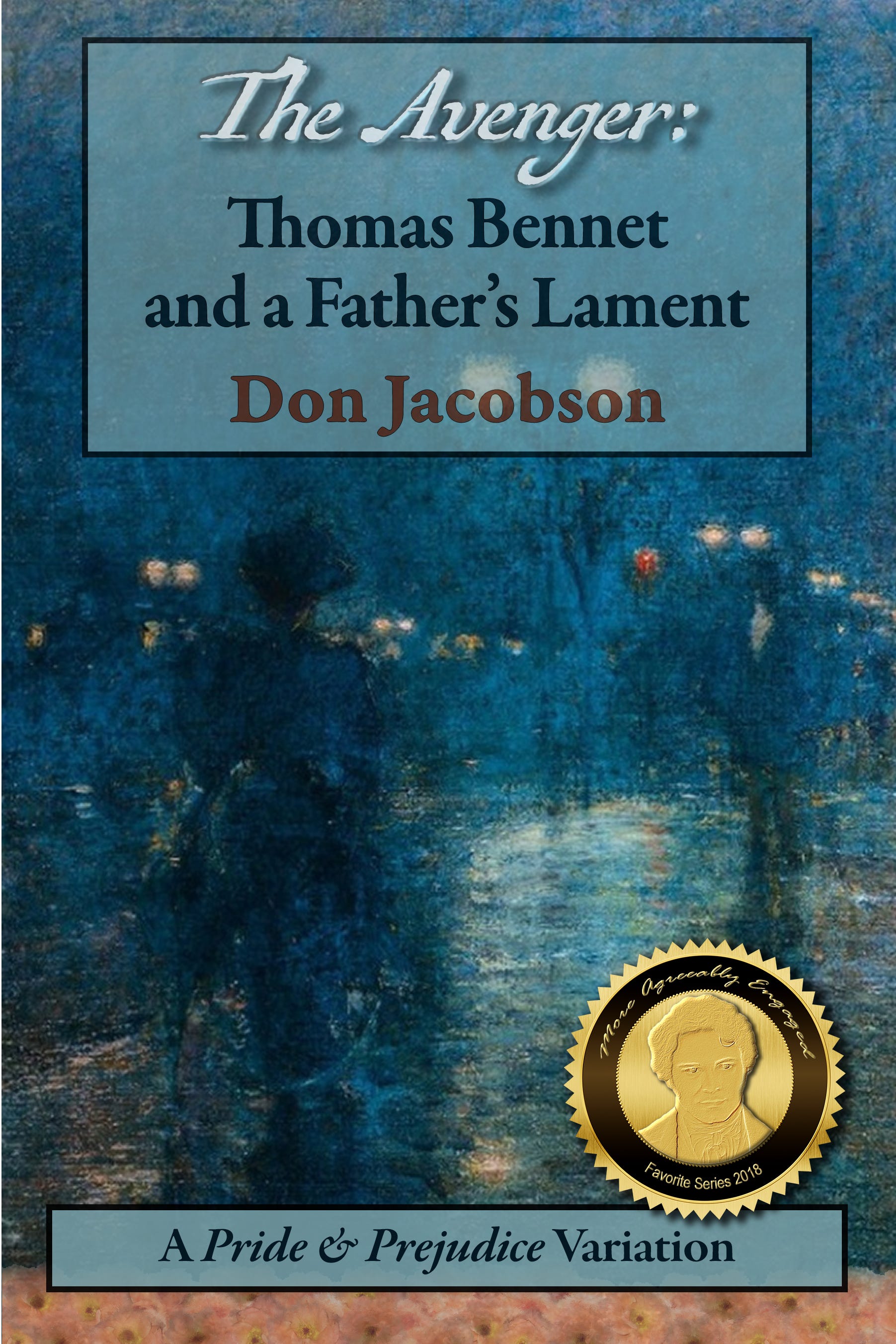
The Classic Cover
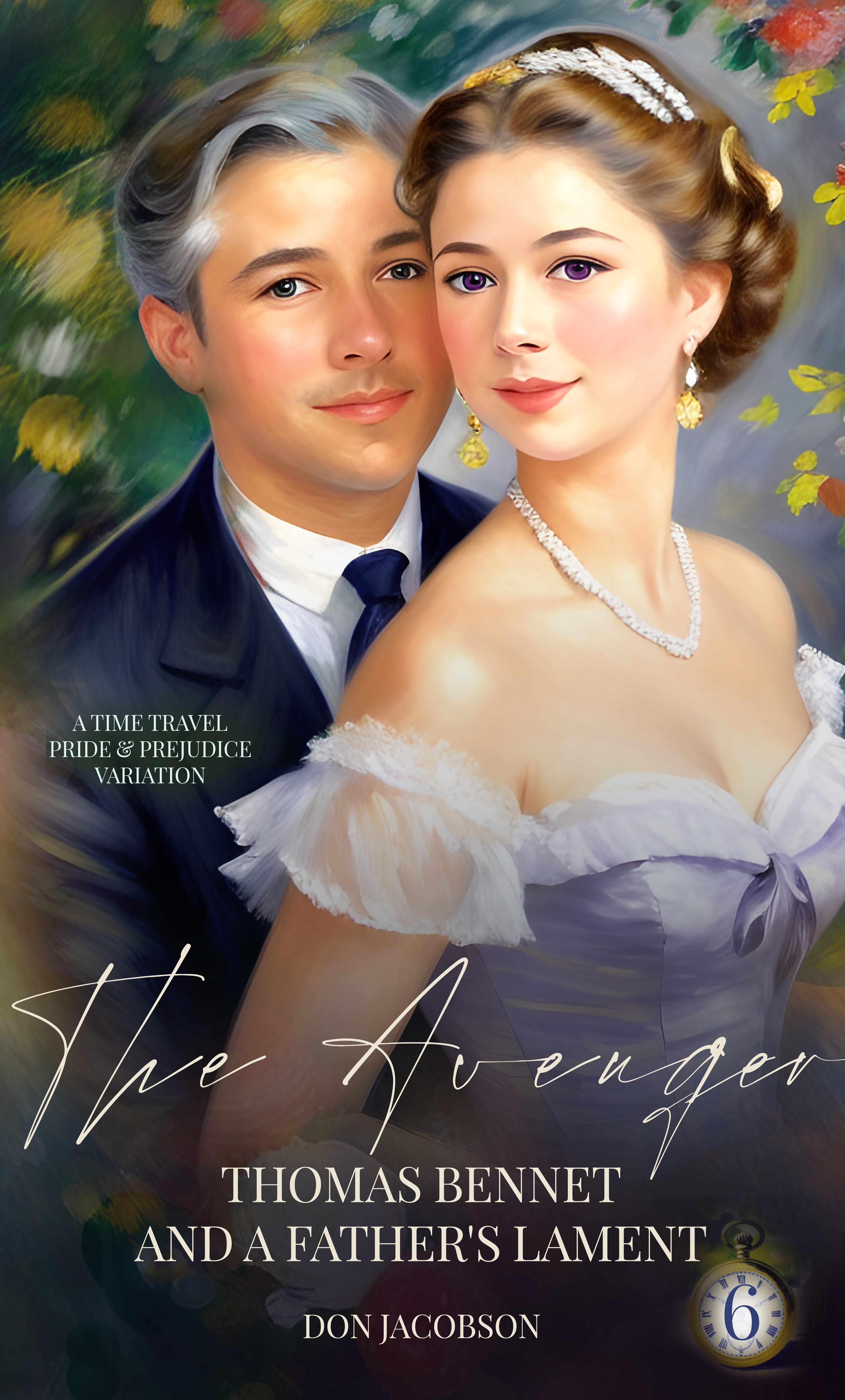
New Look Cover (2023)
&&&&
This excerpt is ©2018 by Donald P. Jacobson. Reproduction is prohibited.
Lt. Colonel Richard Fitzwilliam, retired, a former SOE agent, Preacher, has fallen in love with Eileen Nearne, a former SOE agent, Rose. His feelings are reciprocated. The couple is coming close…so close. Mrs. Bennet needs to nudge her at the 1948 Netherfield Harvest Ball.
Chapter Thirty-six
The waltz had left her breathless—not from exertion but emotion. Feelings suppressed for over four years roared back to life like a house fire supposedly extinguished but with a few hidden embers still smoldering. The oxygen that was his touch, his glance, his voice fueled the fever coursing through her soul, so receptive now after her years under Miss Freud’s tutelage.
In recent months, whether in casual company at The Beach House or cloistered together above the worktable that dominated the Anubis chamber, she had dared to hope, to pray that he might regard her as something other than a skilled agent. Yet, she had feared that, even if he respected her professional capabilities, he would be unable to open his heart to the woman who had tried to snuff his candle.
Try as she might, Eileen could not tamp down the tremblings of the disloyal cord that stretched through her core whenever she considered a future with Richard Fitzwilliam.
The worst betrayal, though, was dreamtime. During her work with Miss Freud, her night world had become remarkably active as her mind completed what she had begun each day in the consulting room. In the months since she had shifted from classic analysis into a schedule more suited for maintenance, Miss Nearne’s reveries had left the past behind and begun to explore possible futures. The most common themes were visions of peaceful fields, mountains, freshets pouring down from glaciers, and waves scouring the shore. Their idyllic nature was always benign. What sent a charge through her was the revelation that another presence was observing the vistas along with her. The sense of sharing was profound, and unlike any she had ever experienced. The completeness of the moment was only possible because Richard was there by her side. Awakening left her empty, knowing their singularity was a dream, not a reality.
As she stood next to Mrs. Bennet, watching Richard’s scarlet and Mr. Bennet’s inky backs recede, Eileen felt confused, a dislocation resulting from the sudden fracturing of that tenuous bond between two hearts. Only when Fanny gently threaded her arm through Eileen’s to guide her from the floor did she snap back into the present. She heard Mrs. Bennet whispering, chatting her up casually as if the lady were seeking to cover Miss Nearne’s momentary loss of composure. “Now, my girl, if I know those two, they will be gone for some time, at least long enough to down a brandy and puff a cigar.
“As for us, perhaps a glass of punch would be in order. I know it is not authentic, but Lizzy swears this champagne brew is unlike anything you have ever enjoyed. ’Tis a mixture of fruit marinated in rum and ample bubbly. Sorbet is added at the end to make the most exquisite floating islands!”
The two ladies strolled to the side of the parquet to enjoy the cool air drifting in through terrace doors thrown open to relieve the stuffy atmosphere. Eileen had remained monosyllabic as Fanny prattled on, preferring to carefully sip the fizzy rose-tinted concoction lest she dribble some on her gossamer gown.
Her attention was drawn to the woman at her side when the flow of the conversation shifted. Lowering her voice, Fanny switched to the heart of the matter that had been central in Eileen’s thoughts. “You, my darling girl, need to attend to me now. I never spoke thus to any of my daughters as they came of age, for I was still far too foolish and had not yet found the strength to forgive myself for my fear.
“For too long, I urged the girls to give a man what he wanted. Of course, in our age, that did not mean what he could only obtain from a virtuous girl after the vicar had done his work. Instead, I intimated future raptures. That led me to push the girls to advertise themselves in the most vulgar way.
“Luckily, both Jane and Lizzy refused to heed me. I doubt Mr. Darcy would have had Lizzy if she had thrust her chest at him. Poor Bingley probably would have had an apoplexy if Jane had done anything so forward. Then again, Janie likely would have preceded him into the hereafter, expiring from embarrassment.
“What I have learned—thanks to a good man who took the time to love me anew—is that all a man wants is nothing more and nothing less than a woman’s honest and authentic self.
“Give him that ultimate gift, and he will hold that gem in his cupped hands, cherishing it all his days.
“Expressing your heartfelt love will never play you false.”
Eileen tilted her head to the side, looking down at Fanny quizzically, one question plaguing her. “But, Mother Bennet, how will I know whether Richard cares? I always feel yearning, both when I am with him and when I am not. He is friendly, to be sure, but how will I know whether he feels more for me—desires me as I do him?
“I am frightened to confront him. I worry that I will drive him away if I declare myself. We have so much baggage.”
Fanny looked up at her. “You trust Richard, do you not?”
“With my life,” came back the firmest of declarations.
“Your life: and so you did once before back in 1945. From what you told me of your encounter on the cliffs, your body was not yours. Another was executing an awful compulsion. You were trapped inside, an observer.
“But, somehow, you found the power to thwart the attack.
“However, what you did through saving Mr. Fitzwilliam could have led to your death. You, though, did not care. His life was more important than yours. You were in love with him even then.
“And, at some level, Mr. Fitzwilliam knows that.
“You need to trust him to discover his feelings for you. I do not doubt that he is in love with you. Anyone watching him can see that Cupid’s arrow has pierced him,” Mrs. Bennet affirmed, “And, as with most matters of the heart, ’tis up to the lady to force the issue.
“I am not suggesting that you march up to Richard like one of Mr. Wagner’s Valkyries. That would be decidedly improper in this here/now and in my own. Rather, use the power of your presence, your silent being, to inspire him to speak the truth inscribed on his heart.”
“If the disciple John wrote of your beloved, the truth shall set him free.”
Out of the corner of her eye, Fanny espied a flash of scarlet moving past the ballroom’s entryway, heading toward the first set of doors leading onto the terrace. Eileen was unaware of this as she faced the refreshment table at the rear of the room.
Fanny counted to ten to allow the colonel to begin to make his way down the darkened verandah. Then she suggested that Eileen accompany her outside for some fresh air.
***
As she passed through the door onto the balcony and into the darkness, Eileen flew forward as Mrs. Bennet firmly planted a hand in the small of her back and pushed. The French doors clicked shut, effectively cutting off any retreat. Eileen turned to see Mrs. Bennet’s shadow on the other side of the sheer drapes blocking any intrusion from the ballroom.
Taking a relaxing breath, Eileen stepped across the tiled deck toward the balustrade. Reaching that barrier, she planted both hands on it and lifted her face toward the starry dome arcing overhead.
The sound of approaching boot heels brought her chin back toward her chest.
“Miss Nearne?”
“Yes, Mr. Fitzwilliam, ’tis me,” she whispered…and said nothing more.
Richard’s distinctive chuckle bounced off Netherfield’s high walls and echoed out over the manicured grounds, visible only in the imagination of those who had seen them in daylight. The sound sent happy tingles rioting up and down Eileen’s spine, but she kept her peace.
Fitzwilliam, nervous at her ongoing silence, moved to fill the gap, offering up an explanation for his laughter. “We are pawns, Miss Nearne. Can you feel two grandmasters moving us about a giant chessboard?
“Let me guess; Mrs. Bennet offered that you might wish to break the heat of the ballroom with a pass along the terrace.”
At this, Eileen dipped her head in assent but remained silent.
After this second display of reluctance to engage, Fitzwilliam was completely disequilibrated.
He stepped closer and, in a hushed tone, went to where men often visit when the object of their affections goes quiet. “Miss Nearne, Eileen, what have I done? Are you angry with me? Please tell me so that I can make it right!”
His answer came when Eileen granted him a measure of mercy and turned his way, laving his troubled soul with the gentle waters of a loving look that soothed him without words. The Preacher, a man honored by his king for conspicuous bravery, took courage from the warmth radiating from those sky-blue windows into her soul. The message was unmistakable.
He reached out and took both of her hands in his. A Mona Lisa smile lifted the corners of her lips.
Fitzwilliam cleared his throat. “My dearest Eileen Mary Nearne: allow me to pay my addresses to you using your full name. I have known you as Rose and then later as Dominique, Miss Smith, and, only just before you were taken, as Miss Nearne.
“’Twas not until my return that I knew who you were, Miss Eileen Mary Nearne of Glasgow.
“But I thought ’twas too late for me. You were lost, assumed dead. I devoured your file, but it read as a particularly sparse and sad biography: the ending known before the middle could be appreciated.
“I mourned you and tried to hide my sorrow in my church work in Stromness.
“Then came that remarkable—yes, do not look astonished, my dear—I said remarkable day when you became the instrument of another’s bile. I have since learned that you did something extraordinary to alter the expected outcome.
“I tell you this: what that monster did not know was that he was facing the most potent force in the universe: love, the type of love that transforms the lives of all it encounters.
“Grandmother Bennet has been muttering about agape, exagoras agapis, and synchotikí agape—the Fourth, Fifth, and Sixth Loves—spiritual love, redemptive love, and the love which forgives.
“I tell you this now: neither of us realized how and when we fell in love. Likely, we were in the middle of it before we knew it, but our love shaped that encounter on the path.
“You did what you could to redeem yourself, to become a better version of that poor, tortured woman, usually so skillful with a blade. All because the essential center of you—the true and complete Eileen—would not harm me.
“And I knew the same. Seeing the surprise in your eyes as you lay flat on your back before me. How easy to have thrown you over the edge into the Atlantic below. But I stayed my hand, knowing that I could no more dispatch my love, my agape, than I could cut off my arm.
“Something inside told me this was an awful trick—that the woman I had known would not suddenly strive to kill me.”
Fitzwilliam paused and shivered as memory’s horror passed through him. Then he continued in the face of her widened eyes boring deeply into him. “I felt terribly guilty for a while—not for having struck you senseless but, instead, from the irrational belief that you had gone insane and were seeking your revenge upon me. There was that frightful chance that you blamed me for abandoning you to your fate at the hand of the Germans.
“Lord help me, but I found a perverse sense of relief in the deaths of my brother and his family. Their murders proved that your attack was part of a larger scheme and that you were an unwilling tool.
“Patience became a virtue as I waited for you to recover. How I rejoiced when you did the hard work of tracing the breadcrumbs back into the Swabian forest. That hillside bunker and the squad of black helmets were at the trail’s end. This proved you were with us!
“Throughout this past year, working in harness with you, sharing my waking and sleeping moments with you—someday I will tell you my dreams of you—have been the happiest months of my life.
“I know I am a broken-down old soldier and now, it appears, a failed churchman. But I do have some prospects,” he added with a grin, “and we have our work, which is essential.
“Now, before I lose my courage, allow me to tell you that I cannot proceed in this existence without the assurance of knowing that your heart is as fully engaged, although I believe it to be so, as is mine. Please, Miss Nearne, Eileen, will you do me the honor of agreeing to marry me?”
The last was said hurriedly, leaving Fitzwilliam slightly red-faced and breathless.
Eileen’s hand lifted of its own accord, moving to his face to gently stroke his cheek. Tears pricked at the corners of her big, saucer-like eyes. Her lips parted as a smile began to widen. Her words dispelled any fear he had held. “Oh, Richard, you know my history, my weakness—”
“No, my love, your strength.”
Dipping her head, she said, “As you wish, sir, my strength.
“Yet do not be mistaken. You, Richard Edward Fitzwilliam, were and are my strength. Before Rose emerged to take the burden of killing you, I held on to shreds of sanity that escaped detection by taking solace in your rich steel-gray eyes and comforting manner. You were the better place where my mind fled to escape that concrete hell.
“I knew of your regard, your love, even if you did not. I closely observed you in France. At some level, the Eileen I was retreated to the safety created by your presence, albeit imaginary.
“And, at this moment, I cannot imagine ever being away from the real Richard Fitzwilliam.”
Fitzwilliam dared to begin breathing as his life slipped into a different channel than the one through which it had flowed just seconds before.
He wryly asked, “Is that a ‘yes,’ Miss Nearne? I have never asked for a woman’s hand before, but I have read of the proper forms. Once the gentleman has made his offer, the lady must reply—either in the affirmative or the negative.
“I do hope that I managed to couch my appeal in a less offensive manner than one of our lateral ancestors. I am sure that, in your girlhood, you read Miss Austen’s account of Sir Fitzwilliam Darcy’s first proposal to Miss Elizabeth Bennet. I trust that I exceeded that standard.”
Eileen lifted a gloved hand to stifle a giggle that burbled up from her trim midriff before replying with no less impertinence. “Oh, you and your reading: since you became Anubis Alpha, you have buried your nose in musty report after moldy account. Now, you mention a biography that is well more than a hundred years old in your effort to win my hand!
“I heard about Darcy’s proposal to his Lizzy from her mother, who got it from the lady herself. I assure you that Mrs. Bennet’s account was much more colorful than anything the good lady from Steventon served up in those oh-so-proper times.
“You, however, offered a charming overture, one that any woman, romantic or pragmatic, would receive with pleasure.
“And, thus, my lord viscount, my colonel, my heart, I cannot do less than say ‘Yes, please’ to your proposal. I love you more than air itself.”
Fitzwilliam pulled her to him, celebrating their betrothal by capturing her lips with a kiss that deepened as the seconds passed. At some point, though, Richard could feel Eileen squirming in his arms.
He broke their tight clinch and moved back a few inches, far enough to look down at Eileen and ask with friendly sarcasm, “Trying to run from me so soon? Are my attentions that distasteful?”
Eileen slapped the hilt of the Old General’s saber. “I knew you were happy to hear my acceptance, but then I realized that ’twas your sword poking me in the ribs!”
Fitzwilliam choked on his guffaw, “Oh-my-Gawd, Eileen, you minx! That line was ancient when Mae West used it. Is this what I am to expect in the future?”[i]
Further conversation fell by the wayside when Mrs. Bennet slowly opened the door leading back into the ballroom. Her unspoken message was that it was past time for the couple to return and inform the multitude of their happiness.
***
After Mr. Bennet announced the engagement of the viscount and Miss Nearne, Fanny nestled into her husband’s arms as the band swung into the evening’s final number. The couple moved around the floor, confidently stepping as if they were Len Scrivener and Nellie Duggan in Blackpool’s Empress Ballroom, already assured of another Open trophy. In the year since their arrival, the Bennets had begun—contrary to Tom’s earlier practice of avoiding large terpsichorean gatherings—a weekly habit of venturing onto parquet expanses. While their efforts at some of the Latin dances were laughable—although both Tom and Fanny were the first to chuckle and giggle—their Viennese and traditional waltzes were acknowledged to be particularly compelling.
As Miss Lynn stepped up to the microphone to begin her wartime anthem, “We’ll Meet Again,” Mrs. Bennet sighed loudly enough for her husband to lean back and peer into her eyes.
“Why so wistful, my dear?” Bennet asked, “You certainly have no cause to repine. Your ball is a grand success. You even gave your guests a memorable highlight, a betrothal between two young folks who were clearly in love.
“I can assure you, Fanny, that there was many a dampened hankie, so well-known and beloved are those two.”
Fanny replied, “Oh, I know I am being silly, Tom. However, I cannot shake the feeling that, if I had been a different woman, you might have made a similar announcement at Mr. Bingley’s ball all those years ago. But I gave voice to my imaginary relief and crudely counted my chickens well before they hatched.”
“Mrs. Bennet! I protest!” Bennet bitterly interjected. “You cannot take all the blame upon your narrow shoulders!
“If I had been a better husband—if I had been a man who put his family’s future security before the immediate convenience of a quiet book room—I would have eased your concerns by ensuring each of our girls was well-dowered.
“No, Fanny, I counted upon your meager portion to solve the problem. I comforted myself that none of the world’s concerns would follow me into the hereafter.
“I was such a coward!”
The intensity of his words struck her silent. Into that space, Vera Lynn’s timbre added a philosophical undertone that changed Tom Bennet’s mood.
Keep smiling through
Just like you always do
’Til the blue skies
Drive the dark clouds far away.[ii]
Spinning his wife to arm’s length and then bringing her back into hold, Bennet added with a smile that signaled an end to his unhappy mood. “Yet, Frances Lorinda, you always looked ahead, perhaps lamenting my indolence but doing everything in your power to secure our daughters’ happiness. You were the eternal optimist, preferring to nurture those delicate blossoms that populated our parlor.
“Me? I was content to hide like a thorn amongst all those blooms that, I promise, included you.
“Understand this: blind as I might have been, you, Mrs. Bennet, were, are, and always shall be my rose.”
***
Clipping from The Times of London, Friday, December 31, 1948:
A Family Affair
This past Wednesday saw the wedding of Lord Richard Fitzwilliam, Viscount Selkirk, to Miss Eileen Mary Nearne, late of Glasgow, London, and Meryton, Hertfordshire.
Bishop William Wand performed the sacramental offices at St. George’s Church in a morning ceremony.
Sir Thomas Bennet, Bart., of Longbourn escorted the bride. Countess Elizabeth von Schiller served as Matron of Honor: the Viscount’s cousin, Capt. Denis Robard of St. Denis and Deauville attended the Viscount.
Standing as the bride’s mother, Lady Frances Bennet hosted the wedding luncheon at Matlock House, home of the groom’s parents. The Countess of Matlock and the Countess of Pemberley were co-hostesses.
The couple departed immediately from London Airport in a private Darcy-Bingley Enterprises Constellation for their three-week wedding tour of Bermuda, Jamaica, and Cuba.
[i] Attributed to a performance of Catherine the Great in 1944 where West quipped “Is that your sword or are you just happy to see me?” from Art Cohn, The Nine Lives of Michael Todd. (New York, Random House)1958. P 193. Accessed from https://quoteinvestigator.com/2013/08/20/glad-to-see/#note-7045-1 on 10/11/18.
[ii] We’ll Meet Again, lyrics and music by Hughie Charles and Ross Parker, 1939.
Overewriting is mega-common. I was hugely guilty of it myself. In my thirties, having been lucky enough to attract a starry London agent, I had my first two novels published by Orion/Hachette.
Twenty-five years later, I discovered that they were no longer in print, so I retrieved the copyrights and decided to bring them up-to-date and self-publish them. I was mortified, having rid myself of my youthful wordiness, to find that I'D LOST OVER 12,000 WORDS in each: WHILE THE MUSIC LASTS and GHOST MUSIC!!!
They're now far better-written - and much faster-paced - than they were when THE SUNDAY TIMES very kindly wrote, "The symphony orchestra becomes a universe - all human life is here."
Writers CAN improve with age and experience - at least, those writers who don't just churn out the same old, same old. Well done you!! XXAlice
Your writing always evokes a solid feeling of “being there in the moment.” I look forward to reading the updated versions.